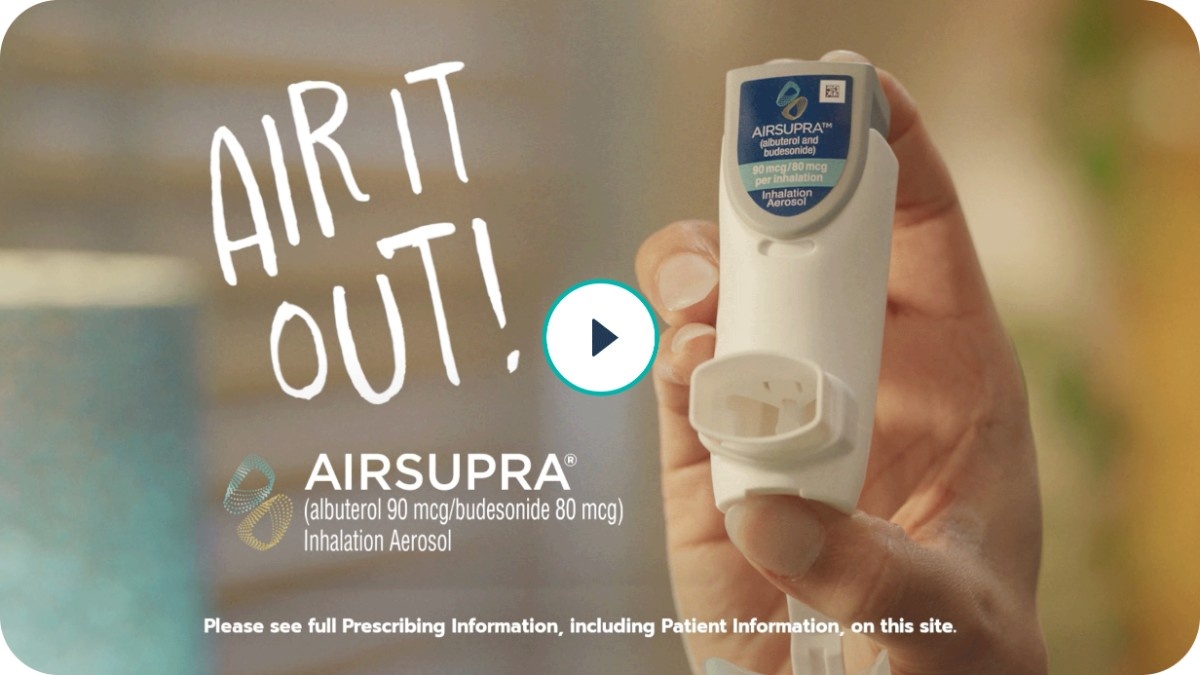
ICS Exposure in Asthma Treatment Transcript
Graphic on screen: AIRSUPRA logo, video title, and a photo of Dr Wendy L. Wright, animate onto screen.
Text on screen: SUPRASESSIONS With Dr Wendy L. Wright, Adult and Family Nurse Practitioner
Graphic on screen: Dots fill the frame. Copy appears in the center and expands, pushing the dots into the corners of the frame. The dots animate in place, while particles highlight the video title.
Text on screen: SESSION 2: ICS EXPOSURE IN ASTHMA TREATMENT
ICS, inhaled corticosteroid.
Graphic on screen: Dots fill the frame, then part to reveal Dr Wright. Text builds next to Dr Wright and a line animates around the copy.
Text on screen: DR WENDY L. WRIGHT, ADULT AND FAMILY NURSE PRACTITIONER
Dr Wendy Wright: Hello, I’m Dr Wendy Wright, an adult and family nurse practitioner. Thanks so much for joining me. Today I’m going to talk about inhaled corticosteroid, or ICS, exposure in asthma treatment. Let’s start with why it’s important to consider ICS in your patient’s asthma rescue treatment.
Graphic on screen: Transition to graph that builds.
Dr Wendy Wright: For decades, patients have relied on SABA-only rescue for relief of their asthma symptoms. But SABA alone doesn’t address inflammation, leaving patients at risk of exacerbations. That’s because inflammation and symptoms vary over time and intensity. And while maintenance therapy helps address baseline inflammation, it may not always be enough to address variability in inflammation, even when patients are adherent to their maintenance therapy. This is where ICS-containing rescue comes into play.
Graphic on screen: Transition back to Dr Wright. GINA logo animates on screen.
Dr Wendy Wright: Global asthma experts from GINA (short for Global Initiative for Asthma)…
Graphic on screen: Text animates on screen, outlined by a moving line.
Text on screen: Supports an anti-inflammatory rescue approach for all adult patients with asthma
Dr Wendy Wright: …support an anti-inflammatory rescue approach for all adult patients with asthma. These experts…
Graphic on screen: Text animates on screen, outlined by a moving line.
Text on screen: GINA has recommended against SABA-only treatment of asthma in adults since 2019
SABA, short-acting β2-agonist.
Dr Wendy Wright: …have recommended against SABA-only treatment of asthma in adults since 2019.
Graphic on screen: Transition back to Dr Wright.
Dr Wendy Wright: When choosing an anti-inflammatory rescue approach for your patients with asthma, a common question might be,…
Graphic on screen: Dots fill the frame. Copy appears in the center and expands, pushing the dots aside. A line animates around the copy. The dots float in the space around the text.
Text on screen: “HOW MUCH ICS EXPOSURE WOULD PATIENTS GET IF USING BOTH AN ICS-CONTAINING MAINTENANCE AND A RESCUE THAT INCLUDES AN ICS?”
ICS, inhaled corticosteroid.
Dr Wendy Wright: …“How much ICS exposure would patients get if using both an ICS-containing maintenance and a rescue that includes an ICS?”
Graphic on screen: Dots fill the frame. Copy appears in the center and expands, pushing the dots aside. A line animates around the copy. The dots float in the space around the text.
Text on screen: RETROSPECTIVE, REAL-WORLD CLAIMS STUDY: 2010-2017 DATA
>500,000 PATIENTS WITH ASTHMA EVALUATED ACROSS ALL SEVERITIES
Dr Wendy Wright: This question was examined in an observational, retrospective US administrative claims study that included data from more than half a million patients who were at least 12 years of age with asthma across all severities.
Graphic on screen: Dots transition to reveal Dr Wright.
Dr Wendy Wright: A key objective of this study was to estimate the daily ICS exposure that would occur if patients were to use an ICS every time they use their SABA rescue for symptoms.
Graphic on screen: Dots fill the frame and the background color lightens. Copy appears in the center and expands, pushing the dots aside as Dr Wright reads through them. A line animates around the copy. The dots float in the space around the text.
Text on screen: REAL-WORLD CLAIMS STUDY
OBSERVED ICS EXPOSURE
Based on post-index claims for ICS-containing maintenance therapies (proportion of days covered)
Assumes full prescription use
Expressed as mcg/day fluticasone propionate equivalents
PROJECTED ICS EXPOSURE
*50 mcg fluticasone propionate equivalent=80 mcg of budesonide.
†Inhalations/day were based on 200 inhalations per canister multiplied by the mean number of post-index canisters filled.
ICS, inhaled corticosteroid; SABA, short-acting β2-agonist.
Dr Wendy Wright: The total estimated ICS exposure was calculated by combining observed and projected ICS exposure. Observed exposure was based on post-index prescription claims, using proportion of days covered and assuming full use of the prescription fills, and was expressed as micrograms per day of fluticasone propionate equivalents. Projected exposure reflected additional ICS exposure if 50 micrograms were delivered with each SABA rescue inhalation, based on mean SABA fills in the post-index year.
Graphic on screen: A bar chart with footnotes appears on screen. Each bar animates upward sequentially from left to right until all data points are displayed.
Dr Wendy Wright: The mean total estimated ICS exposure per day was calculated by adding the observed ICS exposure resulting from maintenance therapy to the projected ICS exposure that would result if every SABA rescue inhalation was combined with an ICS. The mean total estimated ICS exposure per day is highlighted in purple.
Graphic on screen: Orange/red symbols appear above bars, and footnotes change.
Dr Wendy Wright: This study showed that the estimated total ICS exposure from the use of an ICS with a SABA as rescue therapy on top of an ICS-based maintenance therapy did not exceed the daily maximum FDA-approved ICS dosing at each step of therapy, shown in the orange and red gradients.
Graphic on screen: Chart fades out. Dots transition to reveal Dr Wright.
Dr Wendy Wright: Now we will shift to evidence from randomized clinical trials to discuss ICS-related safety of AIRSUPRA and albuterol.
Graphic on screen: Dots transition to create our branded dotted pattern in the corners of the frame and reveal the branded background color. Dots in the corners animate. AIRSUPRA logo grows into place. Text animates into frame as Dr Wright reads the text.
Text on screen: The first and only FDA-approved ANTI-INFLAMMATORY RESCUE that treats bronchoconstriction and helps prevent exacerbations
AIRSUPRA® is a combination of albuterol, a beta2-adrenergic agonist, and budesonide, a corticosteroid, indicated for the as-needed treatment or prevention of bronchoconstriction and to reduce the risk of exacerbations in patients with asthma 18 years of age and older.
FDA, Food and Drug Administration.
IMPORTANT SAFETY INFORMATION
Contraindications: Hypersensitivity to albuterol, budesonide, or to any of the excipients
Deterioration of Asthma: Asthma may deteriorate acutely over a period of hours or chronically over several days or longer. If the patient continues to experience symptoms after using AIRSUPRA or requires more doses of AIRSUPRA than usual, it may be a marker of destabilization of asthma and requires evaluation of the patient and their treatment regimen
Please continue to watch for full Important Safety Information.
Dr Wendy Wright: AIRSUPRA is the first and only FDA-approved anti-inflammatory rescue that treats bronchoconstriction and helps prevent exacerbations. AIRSUPRA is a combination of albuterol, a beta2-adrenergic agonist, and budesonide, a corticosteroid, indicated for the as-needed treatment or prevention of bronchoconstriction and to reduce the risk of exacerbations in patients with asthma 18 years of age and older.
Graphic on screen: Boxes expand into frame; text and inhaler graphics animate in.
Text on screen: AIRSUPRA contains
ALBUTEROL (SABA) for rapid bronchodilation + BUDESONIDE (ICS) to address inflammation
AIRSUPRA 90/80 mcg
2 inhalations PRN for asthma symptoms
No more than 12 inhalations in a 24-hour period
ICS, inhaled corticosteroid; PRN, as needed; SABA, short-acting β2-agonist.
IMPORTANT SAFETY INFORMATION
Contraindications: Hypersensitivity to albuterol, budesonide, or to any of the excipients
Deterioration of Asthma: Asthma may deteriorate acutely over a period of hours or chronically over several days or longer. If the patient continues to experience symptoms after using AIRSUPRA or requires more doses of AIRSUPRA than usual, it may be a marker of destabilization of asthma and requires evaluation of the patient and their treatment regimen
Please continue to watch for full Important Safety Information.
Dr Wendy Wright: Important Safety Information.
Contraindications include hypersensitivity to albuterol, budesonide, or to any of the excipients.
Deterioration of Asthma: Asthma may deteriorate acutely over a period of hours or chronically over several days or longer. If the patient continues to experience symptoms after using AIRSUPRA or requires more doses of AIRSUPRA than usual, it may be a marker of destabilization of asthma and requires evaluation of the patient and their treatment regimen.
Please see additional Important Safety Information for AIRSUPRA at the end of this video.
Graphic on screen: Transition back to Dr Wright. Text animates on screen, outlined by a moving line.
Text on screen: BATURA CLINICAL TRIAL
PATIENTS WITH INTERMITTENT TO MILD PERSISTENT ASTHMA
Dr Wendy Wright: The safety and efficacy of AIRSUPRA were evaluated in a Phase IIIb, randomized, double-blind, patient-centric, event-driven exacerbation trial with a minimum duration of at least 12 weeks in 2421 patients who were at least 12 years of age with intermittent to mild persistent asthma. 26% of patients were taking SABA plus low-dose ICS maintenance therapy or leukotriene receptor antagonists, LTRAs, as their pretrial asthma therapy.
Graphic on screen: Adverse events chart with footnotes appears on screen.
Dr Wendy Wright: In this trial, common adverse reactions reported in greater than or equal to 1% of patients who used AIRSUPRA vs albuterol were headache and cough.
Graphic on screen: ICS-associated adverse events chart with footnotes appears on screen.
Dr Wendy Wright: Here we see the ICS-associated adverse events in patients with intermittent to mild persistent asthma, where ICS-associated adverse events occurred in less than 2% of the participants in each group.
Graphic on screen: Transition back to Dr Wright. Text animates on screen, outlined by a moving line.
Text on screen: MANDALA CLINICAL TRIAL
PATIENTS WITH MODERATE TO SEVERE ASTHMA
Dr Wendy Wright: AIRSUPRA was also evaluated in a Phase III, randomized, double-blind, multicenter, variable-length, exacerbation trial with a minimum duration of 24 weeks in 3040 symptomatic patients who were at least 12 years of age with moderate to severe asthma. All patients in this trial were receiving daily…
Graphic on screen: Continue with Dr Wright on screen. Text animates on screen, outlined by a moving line.
Text on screen: ICS-containing maintenance therapy taken on >75% of the days
Dr Wendy Wright: …ICS-containing maintenance therapy. Patients in this trial reported using their maintenance therapy on average more than 75% of the days.
Graphic on screen: Adverse events chart with footnotes appears on screen.
Dr Wendy Wright: In this trial, adverse events were similar for both treatment arms. The most common adverse events reported in greater than or equal to 1% of patients who used AIRSUPRA were headache, oral candidiasis, and cough.
Graphic on screen: ICS-associated adverse events chart with footnotes appears on screen.
Dr Wendy Wright: The frequency of local ICS-associated adverse events in patients with moderate to severe asthma were similar across treatment arms.
Graphic on screen: Dots fill the frame, then part to reveal Dr Wright. Text builds next to Dr Wright, and a line animates around the copy as it is being discussed.
Dr Wendy Wright: Based on what we’ve covered, let’s recap the key takeaways. We talked about the…
Text on screen: Variability in inflammation in asthma
Dr Wendy Wright: …variability in inflammation in asthma and why maintenance therapy may not always be enough to address it.
Text on screen: ICS exposure from both ICS-containing maintenance and rescue that included an ICS
Dr Wendy Wright: We also examined estimated ICS exposure from both ICS-containing maintenance and rescue if an ICS was included, based on claims data. Finally,…
Text on screen: ICS-associated adverse events in AIRSUPRA clinical trials
ICS, inhaled corticosteroid.
Dr Wendy Wright: …we discussed ICS-associated adverse events in AIRSUPRA clinical trials.
Graphic on screen: Dots in corners animate. Text and QR code animate into frame.
Text on screen: SCAN THIS CODE
TO LEARN MORE ABOUT THE FIRST AND ONLY FDA-APPROVED ANTI-INFLAMMATORY ASTHMA RESCUE AT AIRSUPRAHCP.COM
FDA, Food and Drug Administration.
Dr Wendy Wright: Scan this code to learn more about the first and only FDA-approved anti-inflammatory asthma rescue at airsupraHCP.com.
Graphic on screen: Scrolling Important Safety Information.
Text on screen:
IMPORTANT SAFETY INFORMATION
Contraindications: Hypersensitivity to albuterol, budesonide, or to any of the excipients
Deterioration of Asthma: Asthma may deteriorate acutely over a period of hours or chronically over several days or longer. If the patient continues to experience symptoms after using AIRSUPRA or requires more doses of AIRSUPRA than usual, it may be a marker of destabilization of asthma and requires evaluation of the patient and their treatment regimen
Paradoxical Bronchospasm: AIRSUPRA can produce paradoxical bronchospasm, which may be life threatening. Discontinue AIRSUPRA immediately and institute alternative therapy if paradoxical bronchospasm occurs. It should be recognized that paradoxical bronchospasm, when associated with inhaled formulations, frequently occurs with the first use of a new canister
Cardiovascular Effects: AIRSUPRA, like other drugs containing beta2-adrenergic agonists, can produce clinically significant cardiovascular effects in some patients, as measured by pulse rate, blood pressure, and/or other symptoms. If such effects occur, AIRSUPRA may need to be discontinued. In addition, beta-agonists have been reported to produce electrocardiogram (ECG) changes, such as flattening of the T wave, prolongation of the QTc interval, and ST-segment depression. Therefore, AIRSUPRA, like all sympathomimetic amines, should be used with caution in patients with cardiovascular disorders, especially coronary insufficiency, cardiac arrhythmias, and hypertension
Do Not Exceed Recommended Dose: Clinically significant cardiovascular effects and fatalities have been reported in association with excessive use of inhaled sympathomimetic drugs
Hypersensitivity Reactions, Including Anaphylaxis: Can occur after administration of albuterol sulfate and budesonide, components of AIRSUPRA, as demonstrated by cases of anaphylaxis, angioedema, bronchospasm, oropharyngeal edema, rash, and urticaria. Discontinue AIRSUPRA if such reactions occur
Risk of Sympathomimetic Amines with Certain Coexisting Conditions: AIRSUPRA, like all therapies containing sympathomimetic amines, should be used with caution in patients with convulsive disorders, hyperthyroidism, or diabetes mellitus and in patients who are unusually responsive to sympathomimetic amines
Hypokalemia: Beta-adrenergic agonist medicines may produce significant hypokalemia in some patients. The decrease in serum potassium is usually transient, not requiring supplementation
Immunosuppression and Risk of Infections: Due to possible immunosuppression from the use of inhaled corticosteroids (ICS), potential worsening of infections could occur. Use with caution. A more serious or fatal course of chickenpox or measles can occur in susceptible patients
Oropharyngeal Candidiasis: Has occurred in patients treated with ICS agents. Monitor patients periodically. Advise patients to rinse his/her mouth with water, if available, without swallowing after inhalation
Hypercorticism and Adrenal Suppression: May occur with very high doses in susceptible individuals. If such changes occur, consider appropriate therapy
Reduction in Bone Mineral Density: Decreases in bone mineral density have been observed with long-term administration of ICS. For patients at high risk for decreased bone mineral density, assess initially and periodically thereafter
Glaucoma and Cataracts: Have been reported following the long-term administration of ICS, including budesonide, a component of AIRSUPRA
Effects on Growth: Orally inhaled corticosteroids, including budesonide, may cause a reduction in growth velocity when administered to pediatric patients. The safety and effectiveness of AIRSUPRA have not been established in pediatric patients, and AIRSUPRA is not indicated for use in this population
Most common adverse reactions (incidence ≥ 1%) are headache, oral candidiasis, cough, and dysphonia
Drug Interactions: AIRSUPRA should be administered with caution to patients being treated with:
Strong cytochrome P450 3A4 inhibitors (may cause systemic corticosteroid effects)
Short-acting bronchodilators (concomitant use of additional beta-agonists with AIRSUPRA should be used judiciously to prevent beta-agonist overdose)
Beta-blockers (may block pulmonary effects of beta-agonists and produce severe bronchospasm)
Diuretics or non-potassium-sparing diuretics (may potentiate hypokalemia or ECG changes). Consider monitoring potassium levels
Digoxin (may decrease serum digoxin levels). Consider monitoring digoxin levels
Monoamine oxidase inhibitors (MAOI) or tricyclic antidepressants (Use AIRSUPRA with extreme caution; may potentiate effect of albuterol on the cardiovascular system)
Use AIRSUPRA with caution in patients with hepatic impairment, as budesonide systemic exposure may increase. Monitor patients with hepatic disease
INDICATION
AIRSUPRA is a combination of albuterol, a beta2-adrenergic agonist and budesonide, a corticosteroid, indicated for the as-needed treatment or prevention of bronchoconstriction and to reduce the risk of exacerbations in patients with asthma 18 years of age and older.
You are encouraged to report negative side effects of AstraZeneca prescription drugs by calling 1-800-236-9933. If you prefer to report these to the FDA, call 1-800-FDA-1088.
Please see full Prescribing Information, including Patient Information, by visiting airsupraHCP.com.
Announcer: AIRSUPRA Important Safety Information.
AIRSUPRA is contraindicated in patients with hypersensitivity to albuterol, budesonide, or any excipients.
Asthma may deteriorate acutely or chronically. Continued symptoms after AIRSUPRA or increasing doses of AIRSUPRA may be a marker of asthma destabilization and require evaluation of the patient and their treatment regimen.
AIRSUPRA can produce paradoxical bronchospasm, which may be life threatening. Discontinue AIRSUPRA immediately if paradoxical bronchospasm occurs. Paradoxical bronchospasm frequently occurs with the first use of a new canister of an inhaled formulation.
Drugs containing beta2-adrenergic agonists can produce clinically significant cardiovascular effects in some patients. If these occur, consider discontinuation of AIRSUPRA. Beta-agonists have also been reported to produce ECG changes such as T-wave flattening, QTc interval prolongation, and ST-segment depression. Therefore, as with all sympathomimetic amines, AIRSUPRA should be used with caution in patients with cardiovascular disorders, especially coronary insufficiency, cardiac arrhythmias, and hypertension.
Do not exceed recommended dose. Clinically significant cardiovascular effects and fatalities have been reported with excessive use of inhaled sympathomimetic drugs.
Hypersensitivity reactions including anaphylaxis can occur after administration of albuterol sulfate and budesonide, as demonstrated by cases of anaphylaxis, angioedema, bronchospasm, oropharyngeal edema, rash, and urticaria. Discontinue AIRSUPRA if these occur.
Like all therapies containing sympathomimetic amines, AIRSUPRA should be used with caution in patients with convulsive disorders, hyperthyroidism, or diabetes mellitus and those unusually responsive to sympathomimetic amines.
Beta-adrenergic agonists may produce significant hypokalemia in some patients. Decreased serum potassium is usually transient.
Due to possible immunosuppression from the use of ICS, worsening of infections can occur. A more serious or fatal course of chickenpox or measles can occur in susceptible patients.
Oropharyngeal candidiasis has occurred in patients treated with ICS agents. Monitor patients periodically. Advise patients to rinse their mouth with water without swallowing after inhalation.
Hypercorticism and adrenal suppression may occur with very high doses in susceptible patients. If these occur, consider appropriate therapy.
Decreases in bone mineral density have been observed with long-term administration of ICS. Regularly assess patients at high risk for decreased bone mineral density.
Glaucoma and cataracts have been reported following long-term administration of ICS, including budesonide.
Orally inhaled corticosteroids, including budesonide, may cause a reduction in growth velocity in pediatric patients. The safety and effectiveness of AIRSUPRA have not been established in pediatric patients and AIRSUPRA is not indicated for use in this population.
The most common adverse reactions are headache, oral candidiasis, cough, and dysphonia.
AIRSUPRA should be administered with caution to patients being treated with strong cytochrome P450 3A4 inhibitors, which may cause systemic corticosteroid effects; short-acting bronchodilators (concomitant use of additional beta-agonists with AIRSUPRA should be used judiciously to prevent beta-agonist overdose); beta-blockers, which may block pulmonary effects of beta-agonists and produce severe bronchospasm; diuretics or non-potassium-sparing diuretics, which may potentiate hypokalemia or ECG changes (consider monitoring potassium levels); digoxin, which may decrease serum digoxin levels (consider monitoring digoxin levels); mAOIs or tricyclic antidepressants. Use AIRSUPRA with extreme caution as these may potentiate the effect of albuterol on the cardiovascular system.
Use AIRSUPRA with caution in patients with hepatic impairment as budesonide systemic exposure may increase. Monitor patients with hepatic disease.
These are not all of the side effects for AIRSUPRA. Visit www.airsuprahcp.com for additional information, including full Prescribing Information and Patient Information.
Graphic on screen: Reference list animates in. AstraZeneca logo animates in the bottom left corner.
Text on screen:
REFERENCES
AIRSUPRA® (albuterol/budesonide) [prescribing information]. Wilmington, DE: AstraZeneca Pharmaceuticals LP; 2025.
Chu EK, Drazen JM. Asthma: one hundred years of treatment and onward. Am J Respir Crit Care Med. 2005;171(11):1202-1208. doi:10.1164/rccm.200502-2570E
Data on File. REF-174347. AstraZeneca Pharmaceuticals LP.
Data on File. REF-202630. AstraZeneca Pharmaceuticals LP.
Data on File. REF-267550. AstraZeneca Pharmaceuticals LP.
Global Initiative for Asthma. Global Strategy for Asthma Management and Prevention, 2025. Accessed January 12, 2026.www.ginasthma.org
Kaplan A, Mitchell PD, Cave AJ, Gagnon R, Foran V, Ellis AK. Effective asthma management: is it time to let the AIR out of SABA? J Clin Med. 2020;9(4):921. doi:10.3390/jcm9040921
LaForce C, Albers F, Danilewicz A, et al; BATURA Investigators. As-needed albuterol-budesonide in mild asthma. N Engl J Med. 2025;393(2):113-124. doi:10.1056/NEJMoa2504544
Lanz M, Pollack M, Gilbert, Gandhi H, Tkacz J, Lugogo N. Asthmatic patients are at risk for exacerbations irrespective of control, maintenance adherence, or disease severity. Poster presented at: American College of Allergy, Asthma & Immunology Annual Scientific Meeting; November 10-14, 2022; Louisville, KY.
Larsson K, Kankaanranta H, Janson C, et al. Bringing asthma care into the twenty-first century. NPJ Prim Care Respir Med. 2020;30(1):25. doi:10.1038/s41533-020-0182-2
Lugogo N, Gilbert I, Pollack M, Gandhi H, Tkacz J, Lanz MJ. Estimating inhaled corticosteroid exposure from short-acting β2-agonist-inhaled corticosteroid rescue. J Asthma Allergy. 2023;16:579-584. doi:10.2147/JAA.S408504
Papi A, Chipps BE, Beasley R, et al. Albuterol-budesonide fixed-dose combination rescue inhaler for asthma. N Engl J Med. 2022;386(22):2071-2083. doi:10.1056/NEJMoa2203163
Stein SW, Thiel CG. The history of therapeutic aerosols: a chronological review. J Aerosol Med Pulm Drug Deliv. 2017;30(1):20-41. doi:10.1089/jamp.2016.1297
US Food and Drug Administration. FDA approves drug combination treatment for adults with asthma. Published January 11, 2023. Accessed January 12, 2026. https://www.fda.gov/drugs/news-events-human-drugs/fda-approves-drug-combination-treatment-adults-asthma
AIRSUPRA is a registered trademark of the AstraZeneca group of companies.
©2026 AstraZeneca. All rights reserved. US-107558 Last Updated 6/26