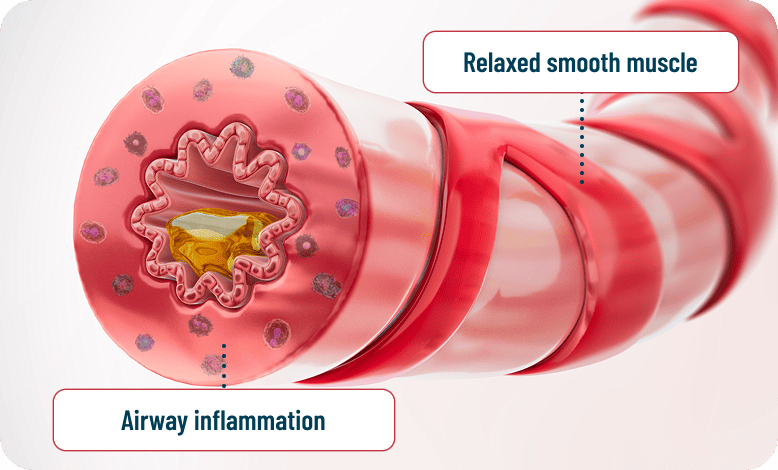
ALBUTEROL-ONLY rescue treats bronchoconstriction but does not address inflammation1,2

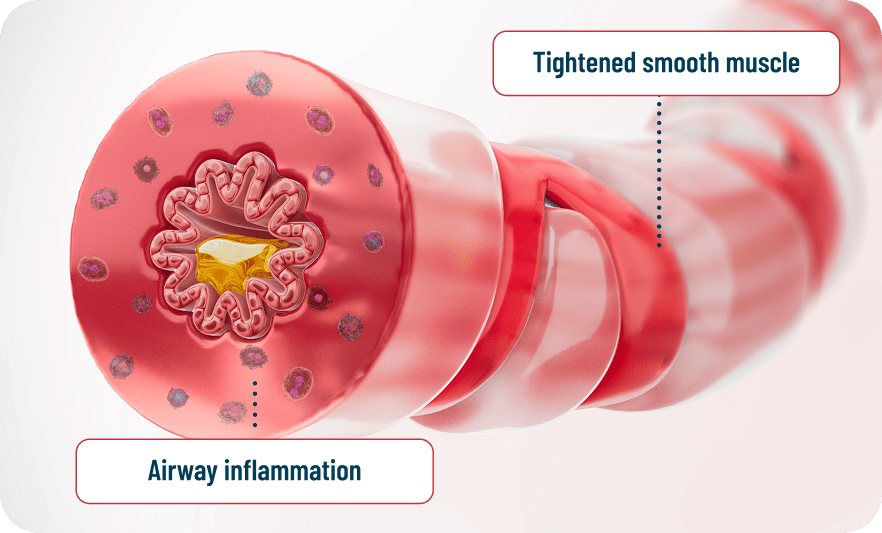
Illustration showing tightened smooth muscle and airway inflammation, demonstrating that asthma is an inflammatory disease with symptoms driven by inflammation and bronchoconstriction Zoom Icon to view full-size image Illustration, showing tightened smooth muscle and airway inflammation

Asthma is an inflammatory disease with symptoms driven by inflammation and bronchoconstriction1,3,4

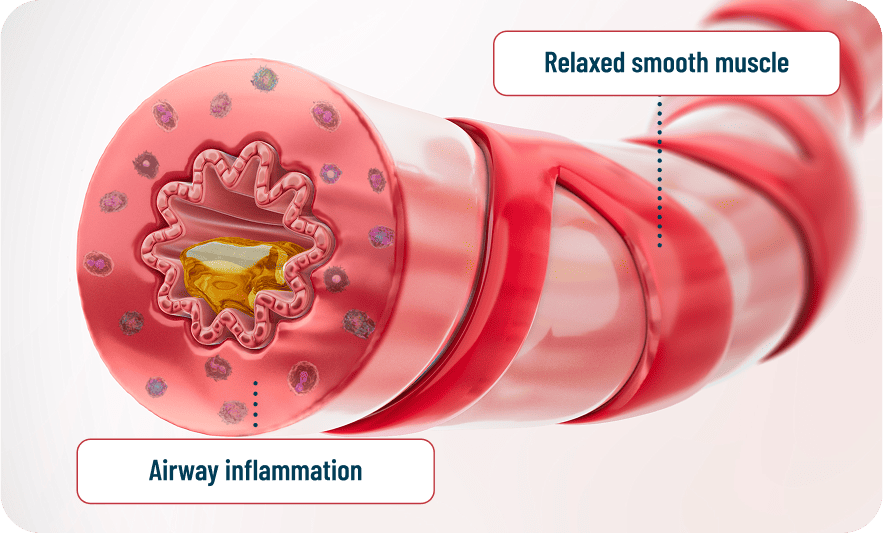
Illustration showing relaxed smooth muscle and airway inflammation, demonstrating that albuterol-only rescue treats bronchoconstriction but does not address inflammation - leaving patients at risk of exacerbationsZoom Icon to view full-size image Illustration, showing relaxed smooth muscle and airway inflammation

Albuterol-only rescue treats bronchoconstriction but does not address inflammation—leaving patients at risk of exacerbations1,2

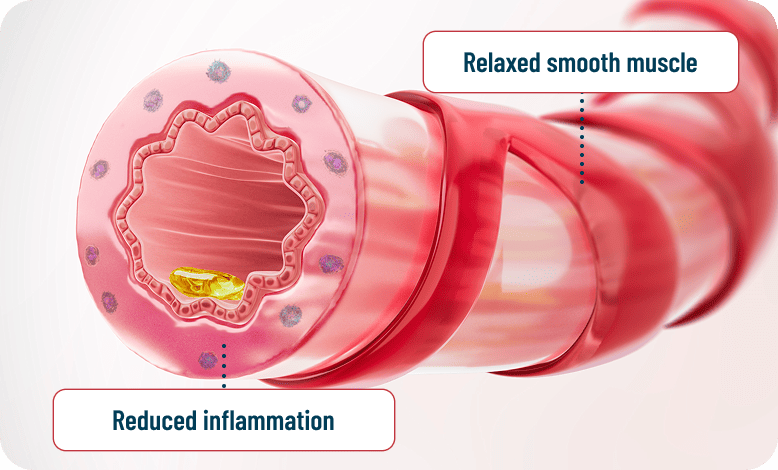
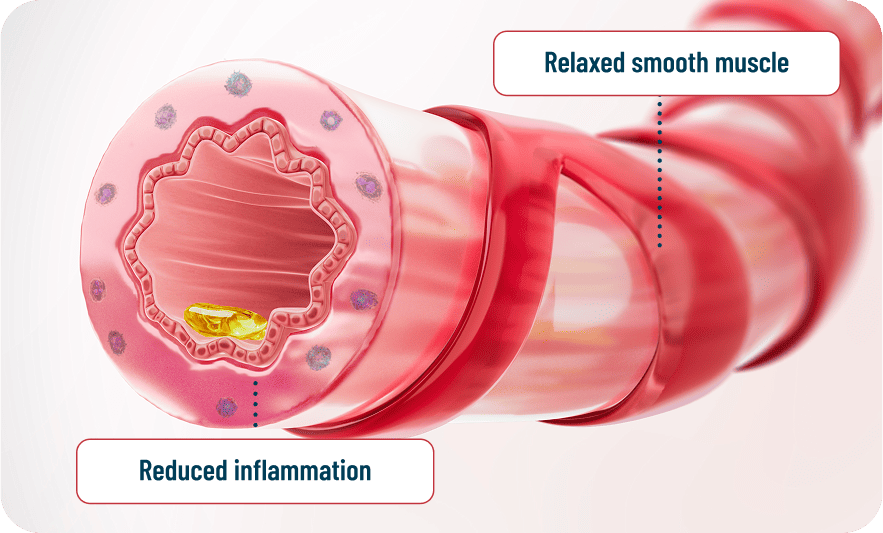
Illustration showing relaxed smooth muscle and reduced airway inflammation, demonstrating that an anti-inflammatory rescue approach treats both inflammation and bronchoconstrictionZoom Icon to View Full-Size Image Illustration, Showing Relaxed Smooth Muscle and Reduced Inflammation

An anti-inflammatory rescue approach treats both inflammation and bronchoconstriction1-3

Transcript

Text on screen: UNDERSTANDING ANTI-INFLAMMATORY RESCUE (AIR)

Graphic on screen: Airway cross-section appears on screen. The cross-section animates to show smooth muscle tightening.

Text on screen: (labels) AIRWAY INFLAMMATION, SMOOTH MUSCLE TIGHTENING

Voiceover: Asthma is a heterogeneous disease. Airway inflammation and bronchoconstriction are key features of asthma...

Graphic on screen: The airway cross-section moves to the upper-right corner of screen. Heading appears with four icons; each icon animates in sync with the voiceover.

Text on screen: ASTHMA SYMPTOMS
(labels) Wheezing, Chest tightness, Coughing, Shortness of breath

Voiceover: ...that are central to driving asthma symptoms such as wheezing, chest tightness, coughing, and shortness of breath.

Graphic on screen: Graph builds from left to right; red INFLAMMATION line animates, followed by blue SYMPTOMS line.

Text on screen: (axis labels) INFLAMMATION, SYMPTOMS, TIME
(disclaimer) Hypothetical illustration of asthma.

Voiceover: Due to the unpredictable nature of asthma, inflammation and symptoms can vary over time and in intensity.

Graphic on screen: Headline builds on screen. Horizontal dotted arrow animates left to right across the graph to point to an ICS inhaler.

Text on screen: MAINTENANCE THERAPY MAY NOT ALWAYS BE ENOUGH
Baseline inflammation: Maintenance therapy addresses baseline inflammation but may not always be enough
(axis labels) INFLAMMATION, SYMPTOMS, TIME
(disclaimer) Hypothetical illustration of asthma.
(footnote) ICS, inhaled corticosteroid.

Voiceover: While daily maintenance therapy helps address baseline inflammation, it may not always be enough.

Graphic on screen: Graph remains on screen; headline appears, and trigger icons populate above graph.

Text on screen: ASTHMA TRIGGERS
(axis labels) INFLAMMATION, SYMPTOMS, TIME
(disclaimer) Hypothetical illustration of asthma.

Voiceover: The variability in inflammation and symptoms can occur when patients are exposed to triggers such as weather, pollen, pet dander, or respiratory viruses.

Graphic on screen: SABA inhalers appear above or next to peaks within the graph.

Text on screen: (labels) SABA
(axis labels) INFLAMMATION, SYMPTOMS, TIME
(disclaimer) Hypothetical illustration of asthma.
(footnote) SABA, short-acting β2-agonist.

Voiceover: Inflammation is central to driving asthma symptoms. In response, patients often reach for their rescue inhalers for relief.

Graphic on screen: Headline appears. The blue SYMPTOMS line goes down while the red INFLAMMATION area pulses and stays the same size.

Text on screen: SABA-ONLY RESCUE TREATS BRONCHOCONSTRICTION BUT DOESN’T ADDRESS INFLAMMATION
(labels) SABA
(axis labels) INFLAMMATION, SYMPTOMS, TIME
(disclaimer) Hypothetical illustration of asthma.
(footnote) SABA, short-acting β2-agonist.

Voiceover: SABA-only rescue treats bronchoconstriction but does not address inflammation—leaving patients vulnerable to rises in inflammation that can lead to worsening symptoms.

Graphic on screen: As graph fades out, blue dots animate in to form blue background. Red box appears and message animates in.

Text on screen: GINA 2024 SUPPORTS AN ANTI-INFLAMMATORY RESCUE APPROACH ACROSS ALL ASTHMA SEVERITIES
(footnote) GINA, Global Initiative for Asthma.

Voiceover: GINA 2024 supports an anti-inflammatory rescue approach across all asthma severities.

Graphic on screen: Closing message and QR code appear on screen.

Text on screen: PATIENTS MAY BE ABLE TO INTERRUPT A RISE IN INFLAMMATION AND PREVENT AN EXACERBATION
SCAN TO BETTER UNDERSTAND ANTI-INFLAMMATORY RESCUE (AIR)

Voiceover: By using anti-inflammatory rescue, or AIR, patients may be able to interrupt a rise in inflammation and prevent an exacerbation.

Graphic on screen: Closing frame with AIRSUPRA logo, AstraZeneca logo, and references appears on screen.

REFERENCES:

1. Global Initiative for Asthma. Global Strategy for Asthma Management and Prevention, 2024. Accessed November 19, 2024. www.ginasthma.org

2. Larsson K, Kankaanranta H, Janson C, et al. Bringing asthma care into the twenty-first century. NPJ Prim Care Respir Med. 2020;30(1):25. doi:10.1038/s41533-020-0182-2

3. National Asthma Education and Prevention Program. Expert Panel Report 3 (EPR-3): guidelines for the diagnosis and management of asthma—summary report 2007. J Allergy Clin Immunol. 2007;120(suppl 5):S94-S138. doi:10.1016/j.jaci.2007.09.043.

4. Lanz M, Pollack M, Gilbert I, Gandhi H, Tkacz J, Lugogo N. Asthmatic patients are at risk for exacerbations irrespective of control, maintenance adherence, or disease severity. Poster presented at: American College of Allergy, Asthma and Immunology Annual Scientific Meeting; November 10-14, 2022; Louisville, KY.

5. American Lung Association. Reduce asthma triggers. Last updated October 23, 2024. Accessed November 19, 2024. https://www.lung.org/lung-health-diseases/lung-disease-lookup/asthma/managing-asthma/reduce-asthma-triggers

6. Gillissen A, Paparoupa M. Inflammation and infections in asthma. Clin Respir J. 2015;9(3):257-269. doi:10.1111/crj.12135

7. Partridge MR, van der Molen T, Myrseth SE, Busse WW. Attitudes and actions of asthma patients on regular maintenance therapy: the INSPIRE study. BMC Pulm Med. 2006;6:13. doi:10.1186/1471-2466-6-13

8. George M, Balantac Z, Gillette C, et al. Suboptimal control of asthma among diverse patients: a US mixed methods focus group study. J Asthma Allergy.
2022;15:1511-1526. doi:10.2147/JAA.S377760

9. Kaplan A, Mitchell PD, Cave AJ, Gagnon R, Foran V, Ellis AK. Effective asthma management: is it time to let the AIR out of SABA? J Clin Med. 2020;9(4):921. doi:10.3390/jcm904091

©2024 AstraZeneca. All rights reserved. US-91152 Last Updated 12/24


Unbranded disease information. This information is not specific to AIRSUPRA.

PATIENTS OFTEN REACH FOR SABA RESCUE FOR RELIEF OF ASTHMA SYMPTOMS1-3

Symptoms include wheezing, chest tightness, coughing, and shortness of breath.4


BREAKTHROUGH SYMPTOMS ARE DRIVEN BY BRONCHOCONSTRICTION AND UNPREDICTABLE RISES IN INFLAMMATION1,5,6

SABA doesn’t address inflammation—leaving patients at risk1,4

Inflammation and Symptom Chart 1 Inflammation and Symptom Chart 1

Baseline inflammation Maintenance therapy addresses baseline inflammation but may not always be enough1,7

This graph is a hypothetical illustration. Adapted from Larsson K, et al. NPJ Prim Care Respir Med. 2020;30(1):25.

By using a fast-acting bronchodilator and ICS as rescue, patients may be able to interrupt a rise in inflammation and prevent an exacerbation1,4,8

GINA 20263

correct

Supports ICS-SABA as the preferred rescue across all treatment steps in Track 2

wrong

GINA has recommended against SABA-only treatment of asthma in adults since 2019

Key recommendations from GINA 20263

  • as-needed low dose ICS-SABA, or, if not available
  • as-needed SABA (closely monitor adherence with maintenance ICS to avoid SABA-only treatment)

*For patients ≥12 years of age.

SEE THE 2025 GINA REPORT

Unbranded disease information. This information is not specific to AIRSUPRA.

Register for updates about AIRSUPRA

AstraZeneca is committed to helping healthcare professionals provide appropriate care to their patients. Please provide us with the above information so that we can keep our records up to date and can send you any information that you request. If in the future you no longer want to receive health-related materials from AstraZeneca, please call 1-800-236-9933. Please visit www.azprivacynotice.com to review our Privacy Notice.

IMPORTANT SAFETY INFORMATION

  • Contraindications: Hypersensitivity to albuterol, budesonide, or to any of the excipients
  • Deterioration of Asthma: Asthma may deteriorate acutely over a period of hours or chronically over several days or longer. If the patient continues to experience symptoms after using AIRSUPRA or requires more doses of AIRSUPRA than usual, it may be a marker of destabilization of asthma and requires evaluation of the patient and their treatment regimen
  • Paradoxical Bronchospasm: AIRSUPRA can produce paradoxical bronchospasm, which may be life threatening. Discontinue AIRSUPRA immediately and institute alternative therapy if paradoxical bronchospasm occurs. It should be recognized that paradoxical bronchospasm, when associated with inhaled formulations, frequently occurs with the first use of a new canister
  • Cardiovascular Effects: AIRSUPRA, like other drugs containing beta2-adrenergic agonists, can produce clinically significant cardiovascular effects in some patients, as measured by pulse rate, blood pressure, and/or other symptoms. If such effects occur, AIRSUPRA may need to be discontinued. In addition, beta-agonists have been reported to produce electrocardiogram (ECG) changes, such as flattening of the T wave, prolongation of the QTc interval, and ST-segment depression. Therefore, AIRSUPRA, like all sympathomimetic amines, should be used with caution in patients with cardiovascular disorders, especially coronary insufficiency, cardiac arrhythmias, and hypertension
  • Do Not Exceed Recommended Dose: Clinically significant cardiovascular effects and fatalities have been reported in association with excessive use of inhaled sympathomimetic drugs
  • Hypersensitivity Reactions, Including Anaphylaxis: Can occur after administration of albuterol sulfate and budesonide, components of AIRSUPRA, as demonstrated by cases of anaphylaxis, angioedema, bronchospasm, oropharyngeal edema, rash, and urticaria. Discontinue AIRSUPRA if such reactions occur
  • Risk of Sympathomimetic Amines with Certain Coexisting Conditions: AIRSUPRA, like all therapies containing sympathomimetic amines, should be used with caution in patients with convulsive disorders, hyperthyroidism, or diabetes mellitus and in patients who are unusually responsive to sympathomimetic amines
  • Hypokalemia: Beta-adrenergic agonist medicines may produce significant hypokalemia in some patients. The decrease in serum potassium is usually transient, not requiring supplementation
  • Immunosuppression and Risk of Infections: Due to possible immunosuppression from the use of inhaled corticosteroids (ICS), potential worsening of infections could occur. Use with caution. A more serious or fatal course of chickenpox or measles can occur in susceptible patients
  • Oropharyngeal Candidiasis: Has occurred in patients treated with ICS agents. Monitor patients periodically. Advise patients to rinse his/her mouth with water, if available, without swallowing after inhalation
  • Hypercorticism and Adrenal Suppression: May occur with very high doses in susceptible individuals. If such changes occur, consider appropriate therapy
  • Reduction in Bone Mineral Density: Decreases in bone mineral density have been observed with long-term administration of ICS. For patients at high risk for decreased bone mineral density, assess initially and periodically thereafter
  • Glaucoma and Cataracts: Have been reported following the long-term administration of ICS, including budesonide, a component of AIRSUPRA
  • Effects on Growth: Orally inhaled corticosteroids, including budesonide, may cause a reduction in growth velocity when administered to pediatric patients. The safety and effectiveness of AIRSUPRA have not been established in pediatric patients, and AIRSUPRA is not indicated for use in this population
  • Most common adverse reactions (incidence ≥ 1%) are headache, oral candidiasis, cough, and dysphonia
  • Drug Interactions: AIRSUPRA should be administered with caution to patients being treated with:
    • -Strong cytochrome P450 3A4 inhibitors (may cause systemic corticosteroid effects)
    • -Short-acting bronchodilators (concomitant use of additional beta-agonists with AIRSUPRA should be used judiciously to prevent beta-agonist overdose)
    • -Beta-blockers (may block pulmonary effects of beta-agonists and produce severe bronchospasm)
    • -Diuretics or non-potassium-sparing diuretics (may potentiate hypokalemia or ECG changes). Consider monitoring potassium levels
    • -Digoxin (may decrease serum digoxin levels). Consider monitoring digoxin levels
    • -Monoamine oxidase inhibitors (MAOI) or tricyclic antidepressants (Use AIRSUPRA with extreme caution; may potentiate effect of albuterol on the cardiovascular system)
  • Use AIRSUPRA with caution in patients with hepatic impairment, as budesonide systemic exposure may increase. Monitor patients with hepatic disease

INDICATION

AIRSUPRA is a combination of albuterol, a beta2-adrenergic agonist and budesonide, a corticosteroid, indicated for the as-needed treatment or prevention of bronchoconstriction and to reduce the risk of exacerbations in patients with asthma 18 years of age and older.

Important Safety Information

+

GINA, Global Initiative for Asthma; ICS, inhaled corticosteroid; SABA, short-acting β2-agonist.

References:

1.Larsson K, Kankaanranta H, Janson C, et al. Bringing asthma care into the twenty-first century. NPJ Prim Care Respir Med. 2020;30(1):25. doi:10.1038/s41533-020-0182-2

2.Kaplan A, Mitchell PD, Cave AJ, Gagnon R, Foran V, Ellis AK. Effective asthma management: is it time to let the AIR out of SABA? J Clin Med. 2020;9(4):921. doi:10.3390/jcm9040921

3.Global Initiative for Asthma. Global Strategy for Asthma Management and Prevention, 2026. Accessed May 12, 2026. www.ginasthma.org

4.National Asthma Education and Prevention Program. Expert Panel Report 3 (EPR-3): guidelines for the diagnosis and management of asthma—summary report 2007. J Allergy Clin Immunol. 2007;120(suppl 5):S94-S138. doi:10.1016/j.jaci.2007.09.043